
Finding Your Child's Learning Style: A Guide for Homeschool Families
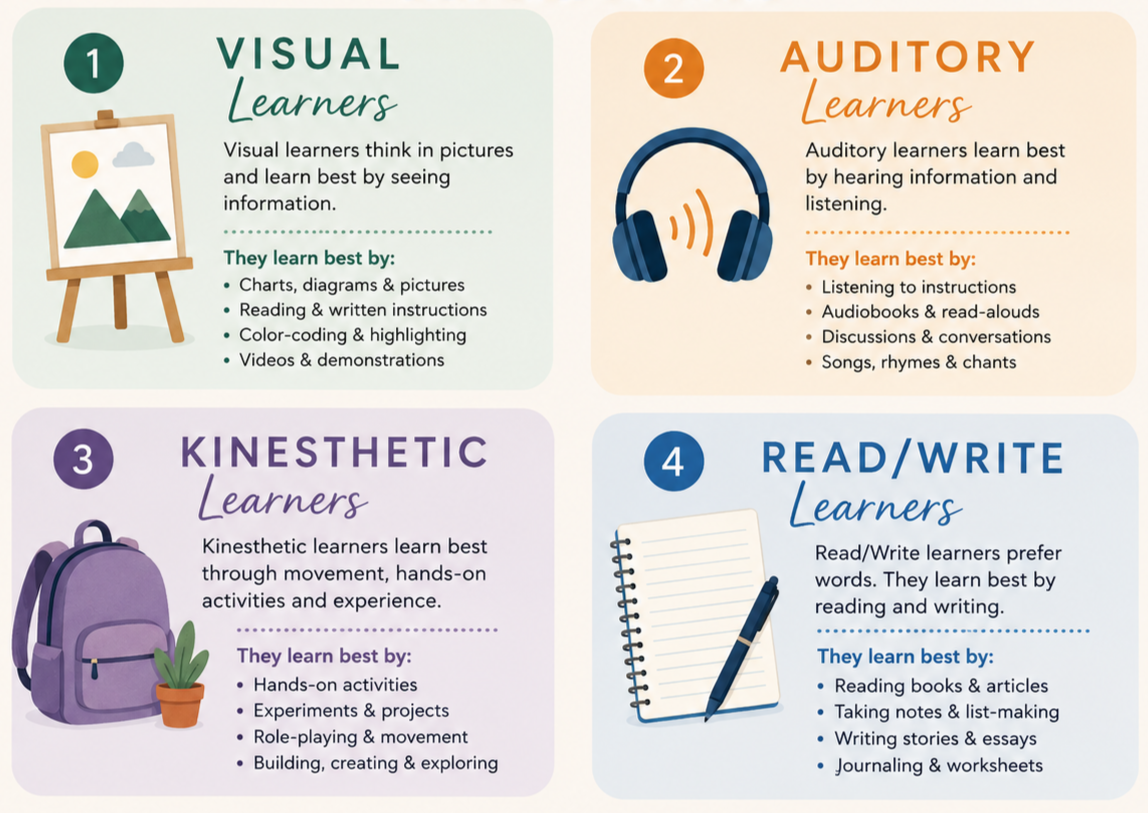
One of the greatest gifts of homeschooling is the freedom to stop teaching the way school was done to you — and start teaching the way your child actually learns. In a traditional classroom, a single teacher must bridge twenty-five different minds. At your kitchen table, you only need to reach one. That shifts everything.
Learning style theory holds that people take in and retain information through different sensory channels — some primarily through what they see, others through what they hear, still others through movement and hands-on experience. While researchers debate the precise mechanics, most veteran homeschoolers will tell you the same thing: when you figure out how your child is wired, lessons go from frustrating to almost effortless.
This guide walks through the four most widely recognized learning styles, how to spot them in your child, and how to shape your homeschool day around them.
The Four Primary Learning Styles
Visual Learners
Visual learners think in pictures. They understand a concept best when they can see it — a diagram, a map, a color-coded timeline. Abstract ideas become real the moment they're drawn out.
Signs your child may be a visual learner:
Gravitates toward books with rich illustrations
Remembers faces and places better than names and dates
Doodles constantly while listening — and it's not distraction, it's processing
Struggles to follow verbal instructions but thrives with written or diagrammed ones
Notices details in their environment that others overlook
Teaching visual learners: Lean into maps, timelines, charts, and illustrated texts. Let them color-code their notes. Use mind maps for brainstorming and narration. When introducing a new concept in math or science, draw it before you explain it. Notebooking — where children illustrate what they learn — was practically invented for these kids.
Auditory Learners
Auditory learners process the world through sound. They remember what they hear, think through problems by talking them out, and often hum or mutter under their breath while working. Rhythm and language are their native tongue.
Signs your child may be an auditory learner:
Loves being read aloud to, long past the age when it seems "necessary"
Picks up song lyrics or spoken poetry with startling speed
Asks "Can you explain that again?" — and a verbal explanation works where a written one didn't
Talks through their thinking, sometimes narrating their own work
Is easily distracted by background noise — because sound is everything to them
Teaching auditory learners: Read aloud generously. Explore audio curricula, history podcasts, and recorded lectures. Let them dictate narrations before they write them. Learn math facts through songs and chants. Discussion-based learning — where ideas are argued and explored verbally before they're committed to paper — is where these children flourish.
Kinesthetic Learners
Kinesthetic learners learn by doing. They need to touch, build, move, and experience. Traditional schooling is often hardest on these children — not because they can't learn, but because they're expected to learn in ways that run counter to their nature.
Signs your child may be a kinesthetic learner:
Can't sit still during lessons and is constantly fidgeting or moving
Learns to tie shoes in one try after watching; struggles to follow the verbal instructions
Prefers building, cooking, crafting, and experimenting over reading about those things
Remembers experiences vividly but forgets facts read from a page
Needs frequent breaks — not because they're lazy, but because their brain runs on movement
Teaching kinesthetic learners: This is where homeschooling truly shines. Build models for history, science, and geography. Do math with manipulatives — base ten blocks, fraction tiles, beans in cups — long past the age when "it should no longer be needed." Let them act out stories for narration. Take the lesson outside. Allow fidget tools during read-alouds. The more learning happens through the body, the more sticks to the mind.
Reading/Writing Learners
Sometimes folded into the visual category but distinct in practice, reading/writing learners are most at home with words on a page. They love lists, definitions, note-taking, and re-reading. The written word is their primary sense-making tool.
Signs your child may be a reading/writing learner:
Would rather read about something than be shown or told about it
Takes notes instinctively — not because they're told to, but because it helps them remember
Keeps journals, writes stories, makes lists for fun
Finds textbooks easier to follow than videos or lectures
Asks for things in writing — schedules, instructions, even chore lists
Teaching reading/writing learners: Give them rich books and plenty of writing time. Narrations work well in written form. Let them take notes during lectures or read-alouds. Copywork and dictation are natural fits. These children often do well with more traditionally structured curricula — because traditional curricula were designed by and for people exactly like them.
A Few Things Worth Remembering
Most children are a blend
Pure types are rare. Your son might be primarily kinesthetic but has a strong secondary reading/writing preference. Your daughter might learn science visually but absorbs history best through story and narration. Watch for patterns rather than forcing a single label.
Learning styles can shift with age
A child who learns kinesthetically at age seven may develop stronger auditory preferences by adolescence as abstract thinking matures. Revisit your observations every year or two. The child you're teaching is not static.
Context matters as much as type
Even a strongly auditory learner benefits from a diagram when the concept is spatially complex. Even a reading/writing learner retains more from a history lesson when they've made something. Learning style theory is a starting point, not a cage. Use it to open doors, not close them.
A simple way to start
Spend one week deliberately offering the same concept through three different channels — read it, draw it, build it — and watch which one produces the lightbulb moment. Your child's face will tell you more than any quiz.
Shaping Your Homeschool Day Around Learning Style
Once you have a working theory of how your child learns, you can begin making small, practical changes to your school day. You don't need to throw out your curriculum. You need to find the on-ramps your child uses naturally — and build more of them in.
Schedule the hardest subjects during peak energy times. Pair challenging concepts with your child's dominant learning modality. Use their secondary strengths to reinforce and review. And above all, trust what you observe. You know your child. That knowledge is worth more than any standardized framework.
Homeschooling is, at its best, an ongoing act of attention — paying close enough notice to one child that you begin to see the world the way they do. Learning style is just one lens for that attention. A useful one. Use it well.
